

If plants could cry out when pained, what would the ancients say about our bond with nature—physical, mental, and spiritual? In Aomori, that question feels less philosophical and more lived. Here, human life seems gently woven into a world that existed long before us. It is as though the people arrived only after the forests were complete, stepping carefully into a living Garden of Eden where flora and fauna had always been sovereign.
In Aomori, you don’t have to venture far to feel it. Even the car parks on the edges of Aomori’s national parks feel like thresholds—places where the human world ends and the wild begins. You leave behind the car, the symbol of modern life, and step into a realm where deer wander freely, butterflies hover at eye level, and black bears still command respect. In Aomori, the boundary between civilisation and nature is porous. You might spend the morning foraging for mountain herbs, only to encounter a deer crossing your path just as you think you’ve returned to “normal life.”
The beech trees at the nearby Shirakami-Sanchi world heritage national park have stood for millennia, quietly witnessing the rise and fall of human civilisations. It is little wonder that Aomori has long embraced a way of living that treads lightly—long before words like sustainability or vegan ever existed.
Forests That Shape Culture and Cuisine
The Shirakami Sanchi beech forest, a UNESCO World Heritage site, began forming around 8,000 years ago. For millennia, its trees have observed the daily dramas of birds, bears, serow, and humans alike. Artists continue to draw inspiration from its scale and serenity; it even served as a reference landscape for Princess Mononoke, that cinematic meditation on humanity’s fraught relationship with nature.
This reverence for the natural world is not abstract. It informs how people forage, how they build, and how they eat. Mountain vegetables (sansai), mushrooms, herbs, and leaves are gathered with care—often taking only what leaves the plant alive. The goal is continuity, not extraction.
It is from this worldview that Kuroyoshi Restaurant emerges—not as an anomaly, but as a continuation.
From Ancient Storehouse to Living Restaurant
Roughly 7,800 years after the Shirakami beeches first reached toward the sky, humans laid the foundations of what would later become Kuroyoshi Restaurant. The structures—traditional storehouses known as kura—were built in 1845 during the Edo period, originally serving the Ikedaya sake brewery.
Kura are architectural testaments to patience and durability. Their thick walls are layered with timber, stone, soil, and straw. Inside the Tenpō‑no‑ma room, a central pillar showcases a construction method normally reserved for temples and shrines, allowing the base of the pillar to be replaced if it rots—an intricate system designed not just to endure, but to adapt.
When the current owners excavated the foundations, they uncovered old tools, now preserved as quiet witnesses to the building’s past lives. What would those walls say if they could speak? What would the original sake brewers think if they knew their storehouse would one day host one of northern Japan’s most quietly radical dining experiences?
Today, these centuries‑old structures house Sousaku Ryori no Mise Kuroyoshi, a creative cuisine restaurant that bridges time periods as seamlessly as it bridges dietary worlds.
Dining in the In‑Between Worlds
Kuroyoshi exists in an in‑between space: between forest and town, past and modernity, vegan and non‑vegan. It is a place where carnivores, herbivores, and the merely curious can sit together at the same table.
Originally a meat‑and‑vegetable restaurant, Kuroyoshi now serves both traditional dishes and an expanding vegan menu. Families, couples, VIPs, and solo travellers dine side by side.
At its heart is owner‑chef Naonori Kikuchi—an architectural thinker, a cheerful host, and an endlessly curious cook. Since late 2022, he has been experimenting seriously with vegan cuisine, not as a trend but as a creative challenge. The result is a menu that invites sceptics in rather than pushing them away.
When Plants Become the Main Event
Seeing, in this case, really is believing.
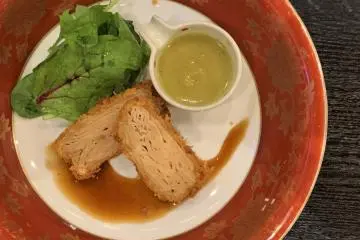
A standout dish is the vegan “steak” made from konnyaku—a humble Japanese yam cake that is 97% water. When prepared properly, it sears, chews, and satisfies like a fatty cut of beef, soaking up umami‑rich glazes with ease. It’s paired better with beer or wine than sake, but it proves a powerful point: pleasure and restraint need not be opposites.
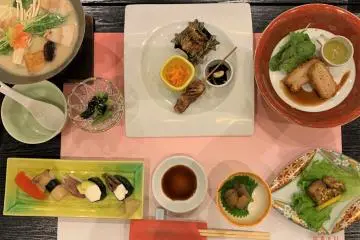
There is vegan pork belly. Vegan beef. Thoughtful vegan sushi with mushrooms, capsicum, ginger, and avocado. The fish substitutes are gentler, but the intent is clear—this is cuisine that invites everyone to the table without demanding ideological purity.
Foraged elements feature prominently. Sansai, mushrooms, and herbs gathered from the surrounding mountains bring the forest directly to the plate. The Dakekimi tempura, made from Aomori’s famously sweet corn, is so indulgent it borders on disbelief. The same corn even appears in dessert form as a silky pudding—proof that vegetables, treated with imagination, can surprise even the most devoted meat eater.
More Than a Meal
Why are people drawn to vegan food—especially when they’re not vegan?
For many, it is altruism, whether spoken aloud or quietly held. Studies suggest that environmentally conscious diners are motivated not just by personal health, but by a desire to reduce harm and act responsibly. In this sense, dining becomes more than nourishment; it becomes participation in a shared ethical landscape.
Japan has long understood this differently. Wabi‑sabi, hara hachi bu (eating to 80% fullness), seasonal ingredients, and careful harvests all suggest that restraint and reverence were embedded in the culture long before modern labels existed. Trees and rice are living organisms too, after all. Eating responsibly has never meant not eating—it has meant eating with awareness.
At Kuroyoshi, that awareness is not preached. It is practiced. You are simply invited to enjoy an excellent meal that happens to tread lightly.
A Table Where Worlds Meet
Foraging in Aomori is not without risk—black bears still roam these mountains, and stories of close encounters circulate quietly among locals. Nature here is not romanticised; it is respected. That same respect extends to the kitchen.
Kuroyoshi is ultimately a place for communion. Vegans and non‑vegans. Locals and travellers. Past and future. You share a meal in a building that has endured for nearly two centuries, built from materials shaped by forests that are thousands of years older still.
In Aomori, you don’t just eat at Kuroyoshi Restaurant. You enter a conversation—one that began long before us, and, if we’re careful, will continue long after.
Getting there
There are hourly trains from Hirosaki, about 30 mins away, though it is much more enjoyable to stay in Kuroishi, for which the restaurant is a short stroll from the town centre.




/140.5954165,40.643752,9/397x132?access_token=pk.eyJ1IjoiamFwYW50cmF2ZWxtYXBzIiwiYSI6ImNqbXBtOXYxbDB5Z3ozbHFrazJuYWMwOGYifQ.v15fy_mcFWtgopmz8PhwqA)